
Project scoping for MSPs
Your project losses are decided the day you quote.
ScopeAssistant drafts the full project scope from your engineer’s notes and your service catalog, and includes the project management time, exclusions, and client responsibilities that usually get left out or underscoped.
Built for MSPs by Raven Automation.
Sound familiar?
You’ve been calling it “the cost of keeping the client”
Every MSP owner we talk to tells the same story about project work. Clients need it, it keeps the managed services contract healthy, but it never makes the money it should. Projects run long. The techs are frustrated. Somebody’s timesheet makes them look slow. And you’ve made peace with it, because the MRR is what matters.
What’s actually going on
The project didn’t lose money in delivery. It lost money at the quote.
Product resale on these jobs is usually dead-on. The leak is in labor, and labor is the one number you set. Scopes get written optimistically because a smaller number is easier to sell. The engineer can’t hit it, so they eat the hours, you eat the margin, and the tech gets blamed for being slow.
The techs aren’t slow. The scope was never finished.
What the typical scope is missing:
- No project management time
- No exclusions
- No client responsibilities
- A quarter of the hours
What it costs
Run the math on your own shop
A 10-to-50 person MSP does roughly one to one-and-a-half projects per employee per year. Quoted labor on a typical one is $8,000 to $10,000, and the overage on that labor runs 20 to 40 percent.
- given away per project
- $2,700
- per employee, per year
- $3,400
- a year for a 20-person MSP
- $45,000 to $90,000
It never shows up as a loss. It shows up as low utilization, as “that project ran long,” or as a tech you’re thinking about replacing.
Pull your last ten projects from your PSA today and compare quoted labor to actual. You’ll have your number before you finish your coffee.
Operator estimates from running our own MSP, not survey data. Your own PSA numbers are the ones that count.
You’ve seen this
The project that went sideways
Somebody scoped it in an afternoon because the client wanted a number by Friday. Three weeks in, the engineer finds the migration needs a piece nobody wrote down.
There’s no exclusion to point at and no client responsibility to lean on, so the account manager doesn’t ask for a change order. That conversation feels worse than the hours.
The project closes. It “made money” on the product. The engineer got a talking-to about efficiency. And you told yourself it was fine because you kept the contract.
That story is running somewhere in your company right now.
A better way
Make the scope the profit decision
The MSPs that stopped bleeding here didn’t hire better estimators or add a fudge factor. They changed what a scope is.
A real work plan
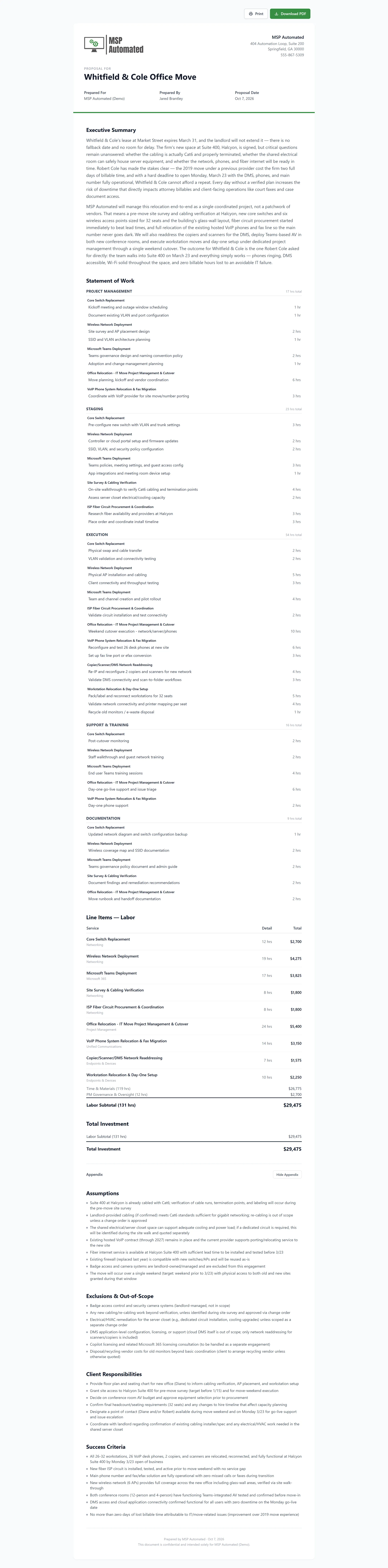
Every project gets one, with hours that reflect the actual work, before the quote goes out.
An executive summary that sells
Explains the problem, the outcome, and why the scope is reliable, so your vCIO can sell it in minutes.
Exclusions that hold up
Written specifically enough to point to when the client asks for “just one more thing.”
Client responsibilities in writing
What the client owes the project is on the page, so a delay on their side isn’t your margin.
Yes, the number goes up. It doesn’t cost you the deal: most project work comes from clients already on your managed services agreement, and they aren’t shopping the quote. Your vCIO spends a few minutes explaining the project management time and why the scope is reliable, and that’s the whole conversation.
Then something rare happens: you start finishing projects under budget. That becomes the reason the client accepts the fuller scope next time, and nobody gets blamed for a number they never agreed to.
How it works
From tech notes to a finished scope
Minutes instead of days, and the money that used to be left off is on the page.
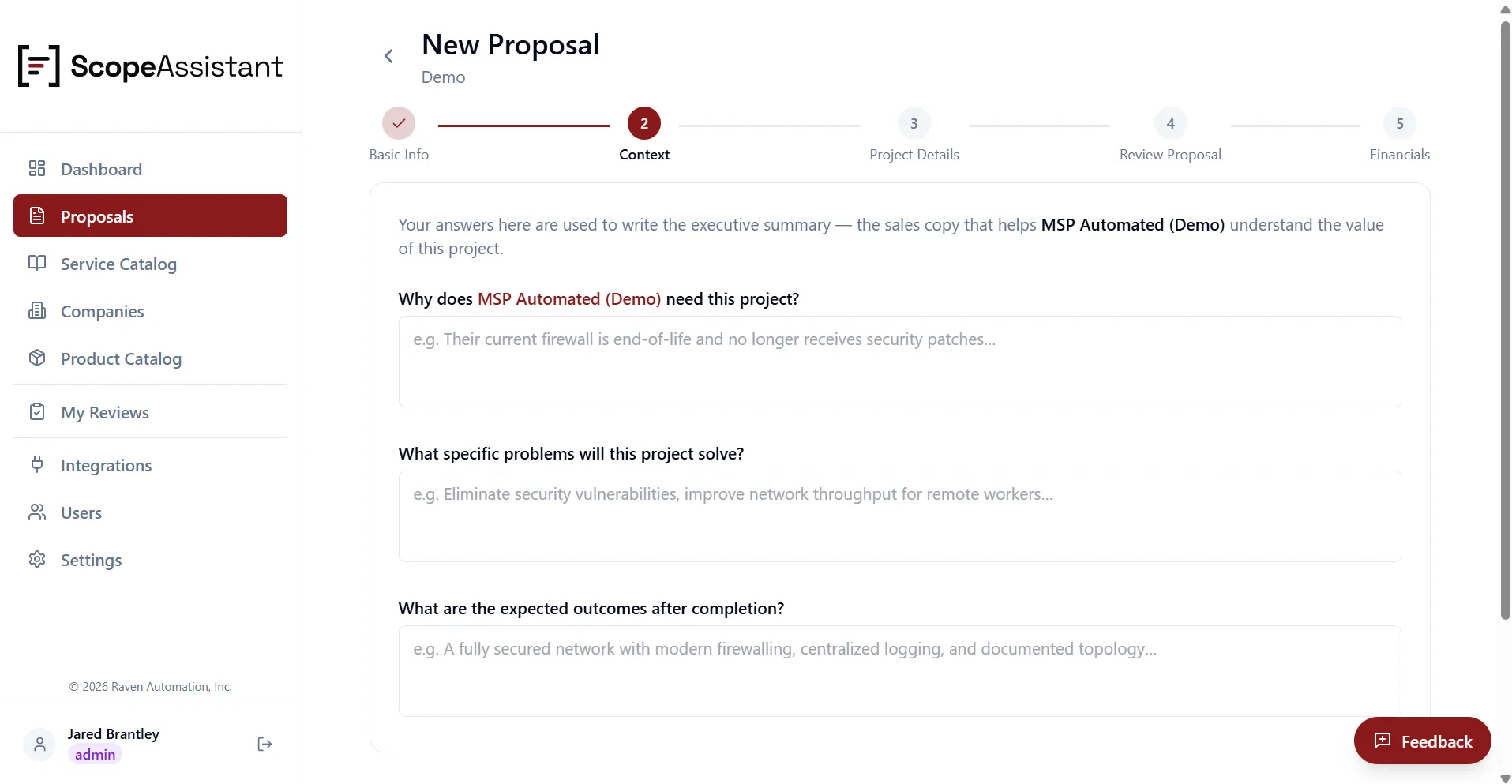
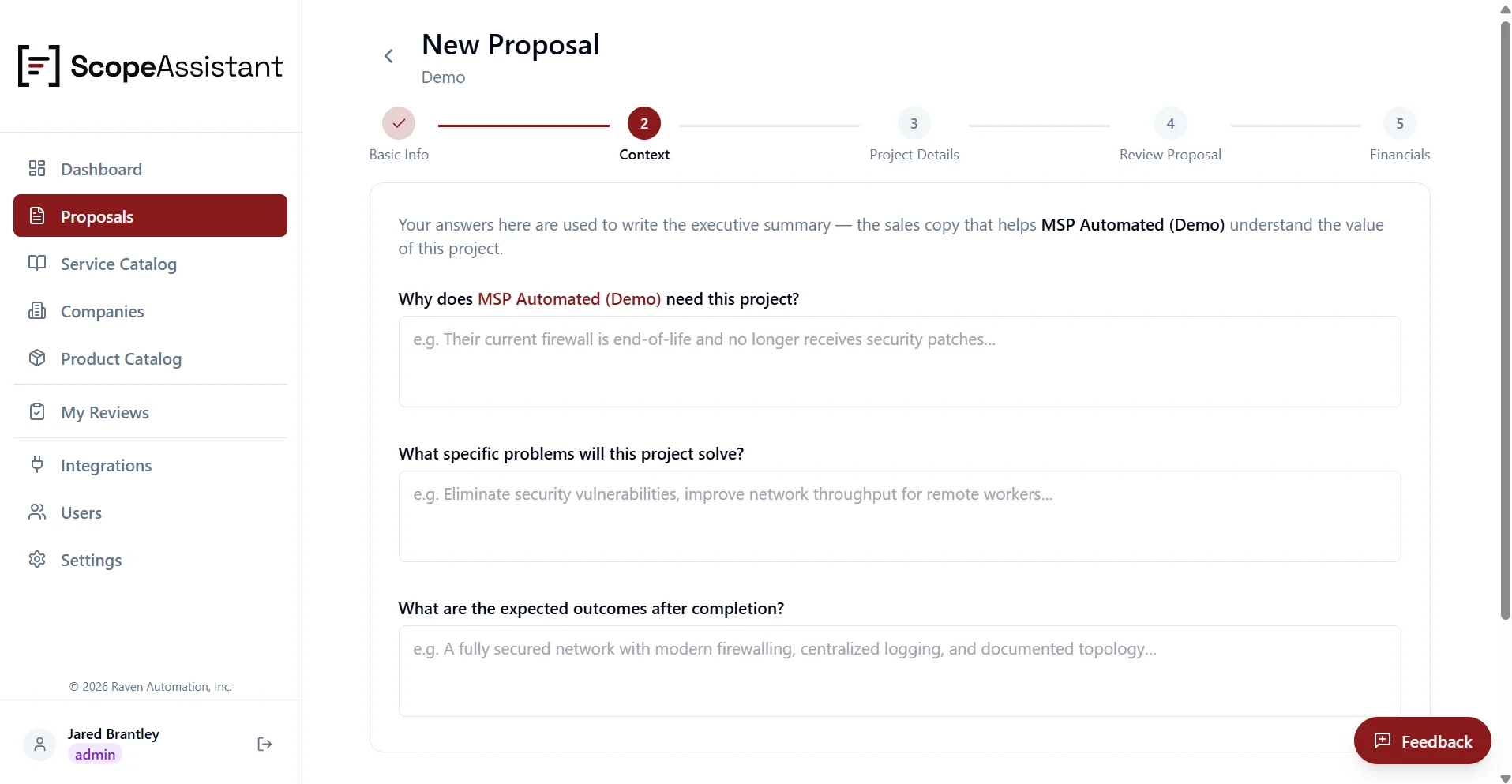
Step 1: Answer a few plain questions
Your engineer works from their own tech notes. No new format, no estimating spreadsheet.
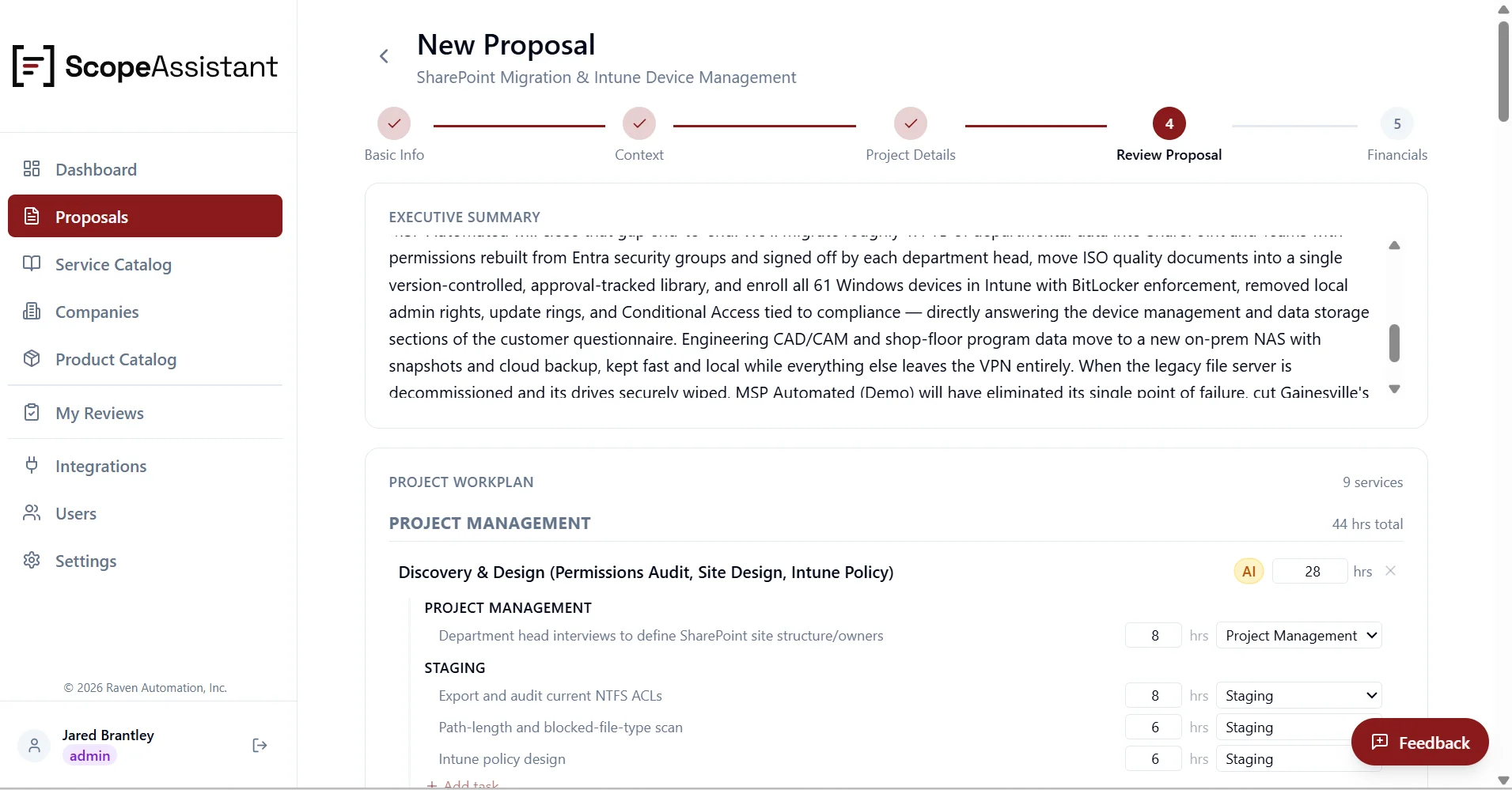
Step 2: Get the whole scope
ScopeAssistant drafts it from your service catalog: work plan, hours, PM line, assumptions, exclusions, client responsibilities, and executive summary. Its job is specifically the parts that get left out.
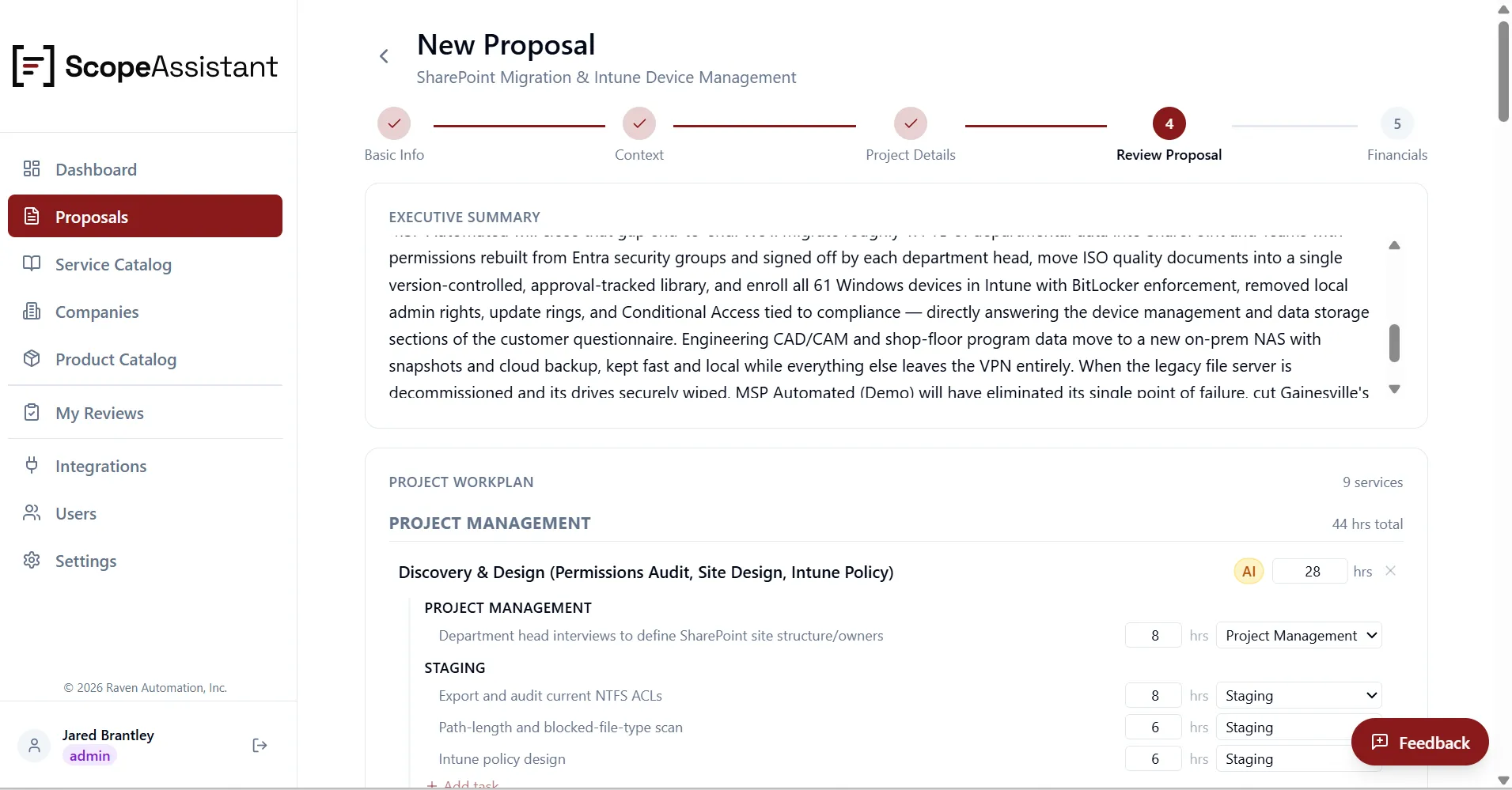
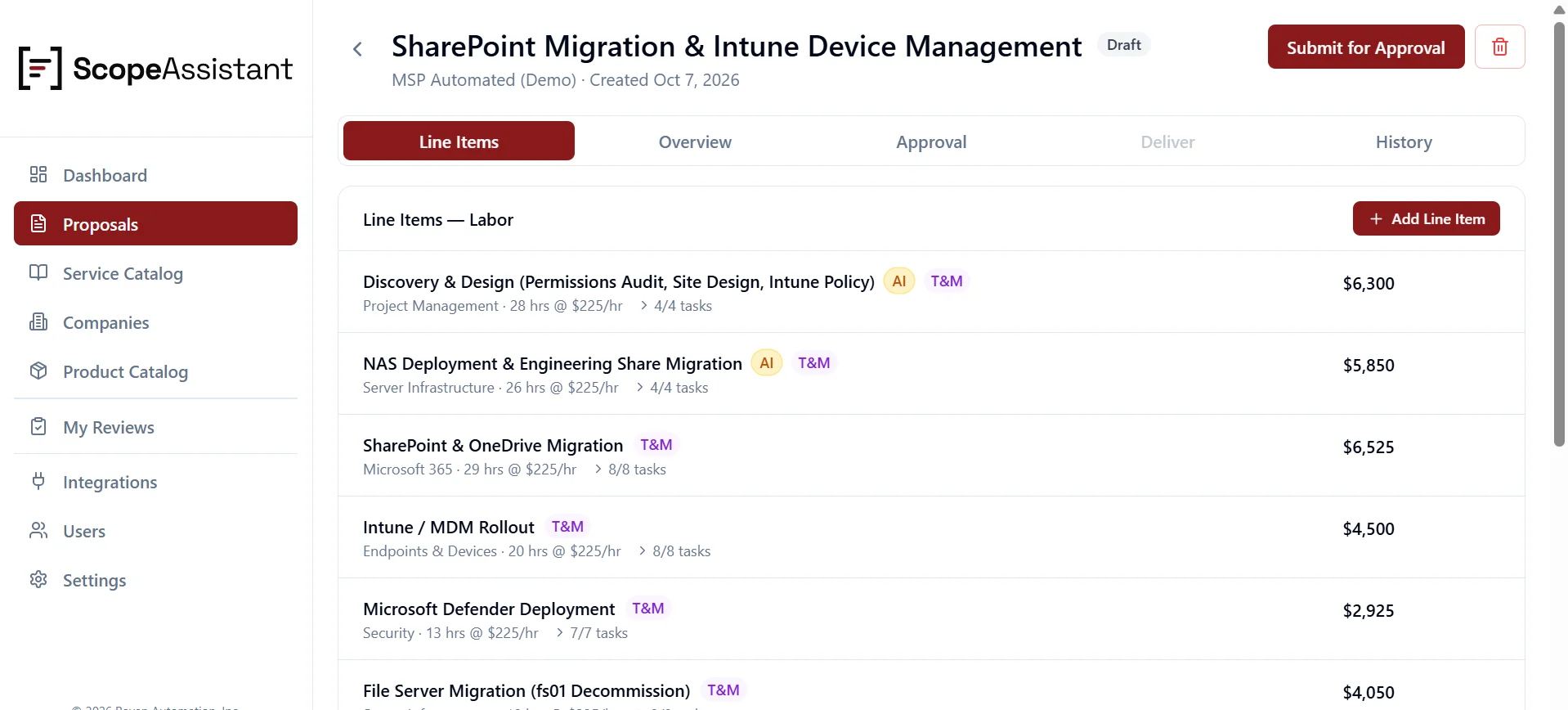
Step 3: Review, approve, and send
Every scope lands in review and a person approves it before a client sees it. Then it’s ready to send.
Features
Built for the parts that get left out
Finds the scope you left out
Templates and chatbots write what you already know. ScopeAssistant looks for what you didn’t write: PM time, exclusions, client responsibilities, and the hours the optimist skipped. It also flags gaps in the scope, work the project needs that isn’t in your service catalog yet.
Built from your service catalog
Scopes use your services, your hours, and your language, so the output looks like your best engineer wrote it on a good day.
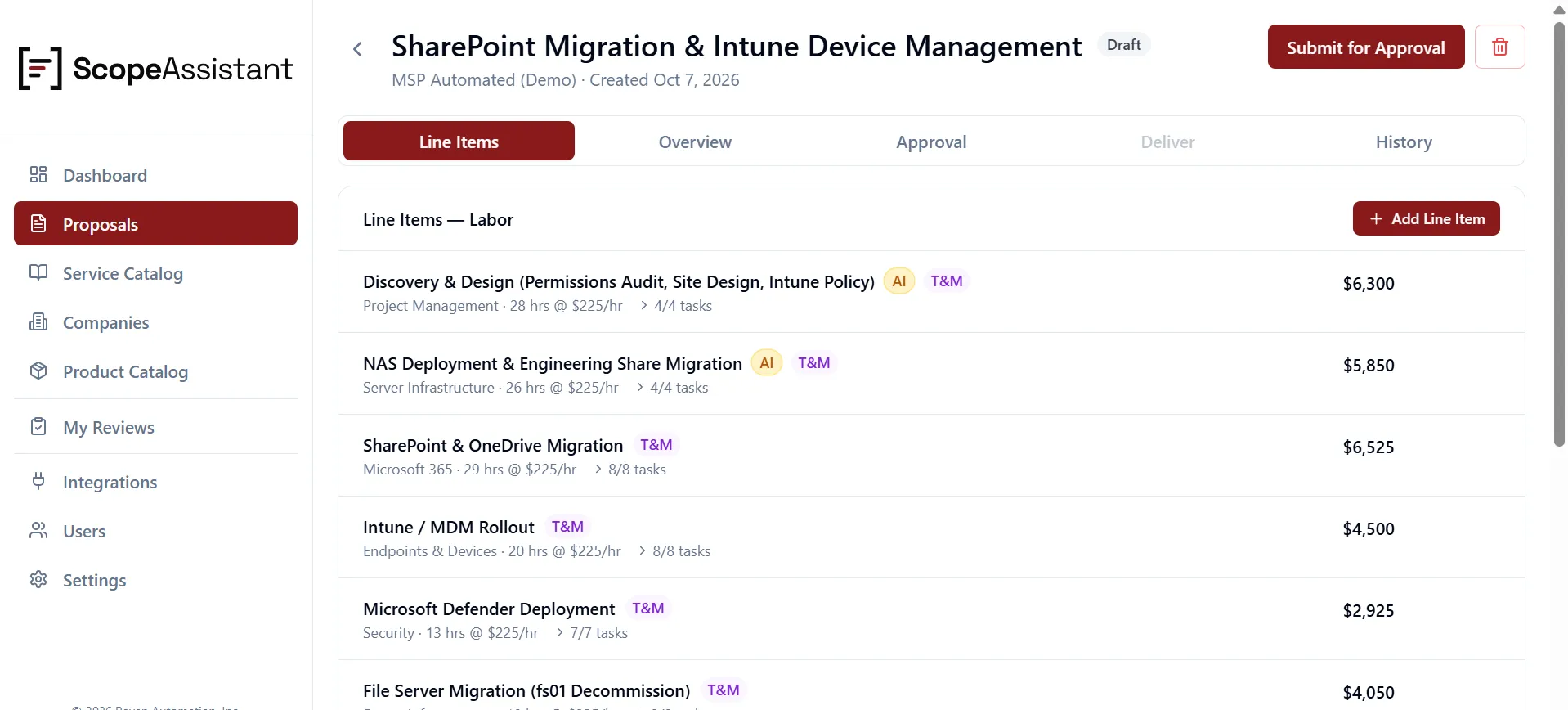
PM time on every project
Project management shows up as its own line item instead of disappearing into the engineer’s hours.
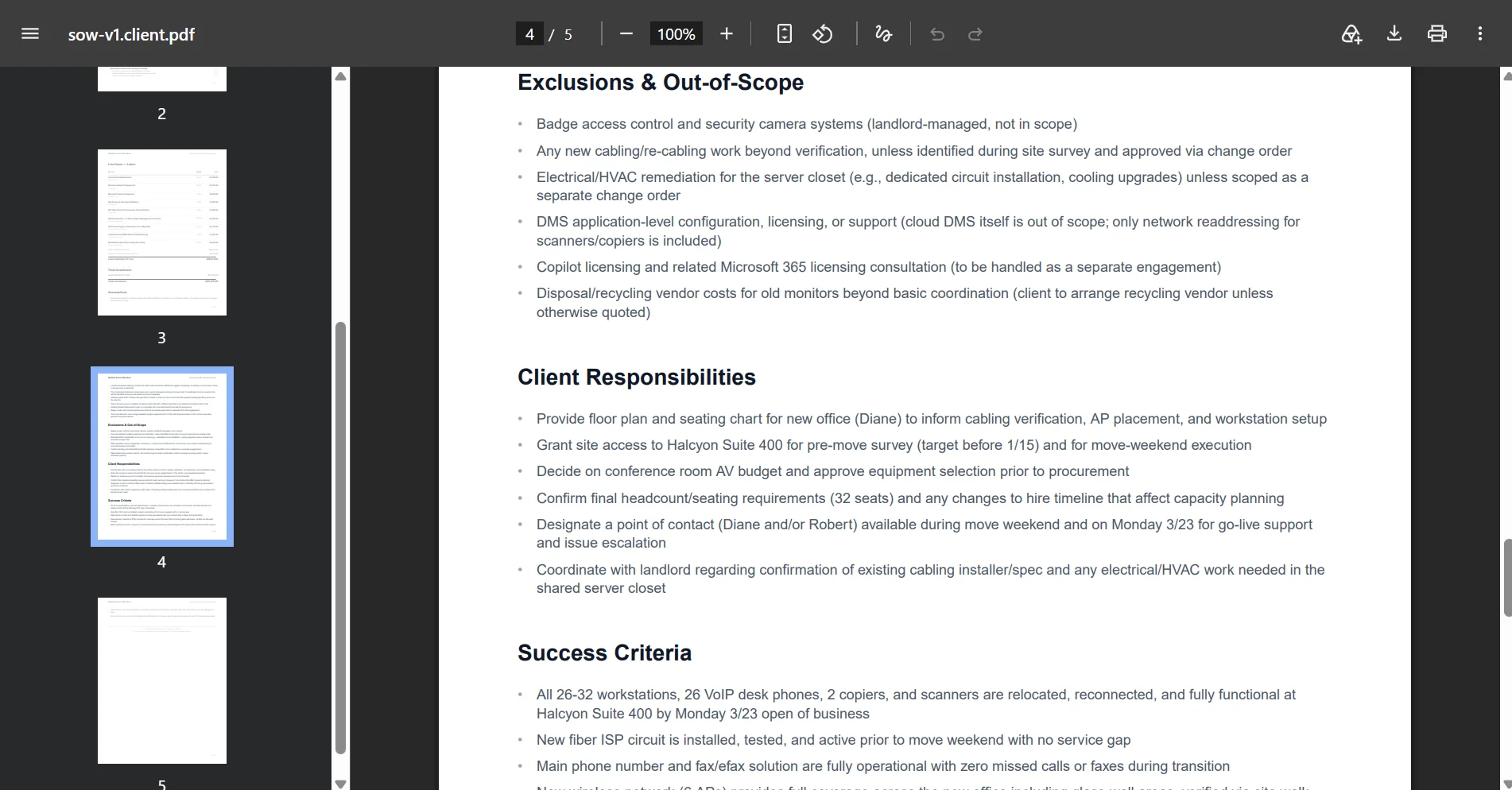
Exclusions and client responsibilities
Specific enough to lean on mid-project, so the change-order conversation is a reference to the SOW, not an argument.
A person approves every scope
Nothing reaches a client until someone on your team has reviewed and approved it.
Connects to the tools you run
Use ScopeAssistant on its own, or connect it to ConnectWise PSA, HaloPSA, and Quoter today, with ConnectWise CPQ and QuoteWerks in development.
Integrations
Works with the tools you already run
Use ScopeAssistant on its own, or connect it to your PSA and quoting tool. We build new integrations around what our customers use.
PSA
- ConnectWise PSALive
- HaloPSALive
- AutotaskPlanned
Quoting
- QuoterLive
- ConnectWise CPQIn development
- QuoteWerksIn development
Fair questions
What owners tell us first
- “My techs just need to be more efficient.”
- Look at the split. Product resale on most projects lands right on budget. The overrun is almost entirely labor, and labor is the one number you set at the quote. Pull your last ten projects and compare quoted labor to actual.
- “Clients won’t pay the bigger number.”
- Most project work comes from clients already on your managed services agreement. They aren’t shopping the quote. Your vCIO explains why the project includes project management time and why the scope is reliable, and finishing under budget does the selling after that. The honest exception is a competitive new-logo bid, where a fuller number carries some risk. That’s also where clear exclusions protect you most if you win.
- “Projects aren’t where we make money anyway.”
- That’s the story that makes the loss feel acceptable. At roughly $3,400 per employee per year, it isn’t a rounding error.
- “We’ll just use ChatGPT or a template.”
- Those write what you already know. The money is lost in what you didn’t write. ScopeAssistant is built to find the omissions.
Bring a project you’re quoting this week
Book a Live Scope Session. Bring your tech notes, we’ll build the scope with you on the call, and you leave with a sample scope either way.